
Are small bottles, several closure types, and separate labeling steps making your oil packaging project difficult to compare? An essential oil filling line must control the dose, handle each bottle and closure, apply the required seal or label, and keep every station working at a practical pace.
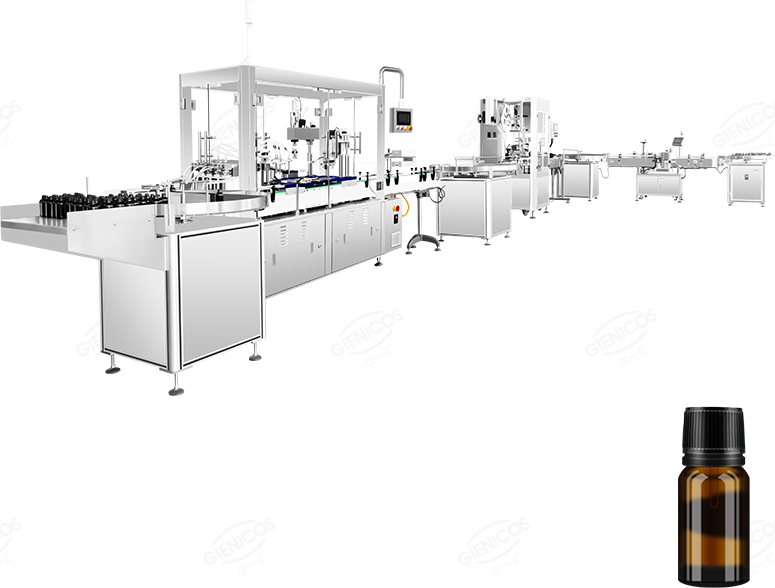
For overseas buyers, the safest starting point is the finished product. GIENICOS offers cosmetic machinery and automation solutions for filling, capping, and labeling. Its JR-4 and JR-4 NEW configurations show how an essential oil filling line can combine these operations for essential oil, face serum, massage oil, medicine oil, and other liquids.
Define the Project Scope Before Comparing Quotes
A quotation is useful only when every supplier is pricing the same process. First list the products, bottles, closures, seals, labels, output target, and factory utilities. Then mark which steps must be automatic and which steps may remain manual.
The GIENICOS JR-4 NEW essential oil filling line includes four-nozzle filling, capping, and labeling functions. The listed application covers essential oil, face serum, and dropper-bottle oil. GIENICOS also lists the JR-4 for essential oil, massage oil, medicine oil, and other liquids, with filling volume up to 200 ml.
Separate Required Stations From Optional Functions
Decide whether the essential oil filling line needs only filling and capping or a wider turnkey scope. The JR-4 NEW product page lists automatic flat-cap or dropper-cap handling, induction sealing, sleeve-shrink labeling for the neck of a flat cap, and round-bottle labeling. These functions should appear as separate items in the technical agreement.
This step keeps missing equipment from hiding behind a low quotation. State who supplies the conveyor connections, labeler, induction sealer, collection table, and equipment after the essential oil filling line.
Match Rated Capacity to Accepted Output
GIENICOS lists four filling nozzles and an output of 1,800 to 2,400 bottles per hour for the JR-4 NEW essential oil filling line. The application description also states that the line can reach 40 pieces per minute. Treat these figures as a starting point for testing, not as the only purchase condition.
Set the acceptance target with the buyer’s product, bottle, closure, and label. Confirm the test format, fill volume, operator count, and running time. Record accepted bottles, stops, and adjustments. This provides a practical basis for comparing the essential oil filling line with planned output.
Check the Slowest Station
Cap sorting, placement, torque control, sealing, labeling, and discharge must stay coordinated. The JR-4 NEW includes a buffer rotary table after filling and capping. GIENICOS states that it supports continued production while an operator replaces labels.
During testing, watch the essential oil filling line when labels are changed, caps are replenished, and bottles are added. A balanced result matters more than a short high-speed demonstration at one station.
Verify Filling Control With Real Product
The JR-4 NEW uses servo-driven piston filling. Its filling nozzles can move up and down under servo control. GIENICOS describes this arrangement as supporting precise filling. The listed utility requirements are 0.5 to 0.8 MPa air pressure, 2.5 kW power, and either 220 V or 380 V in the stated single-phase or three-phase configuration.
Before approving an essential oil filling line, send representative product and packaging samples. Include the lowest and highest fill volumes, main bottle sizes, and a difficult formula. Agree on the fill target, tolerance, sample size, and measuring method before testing.
Test Bottle Detection and Stop Recovery
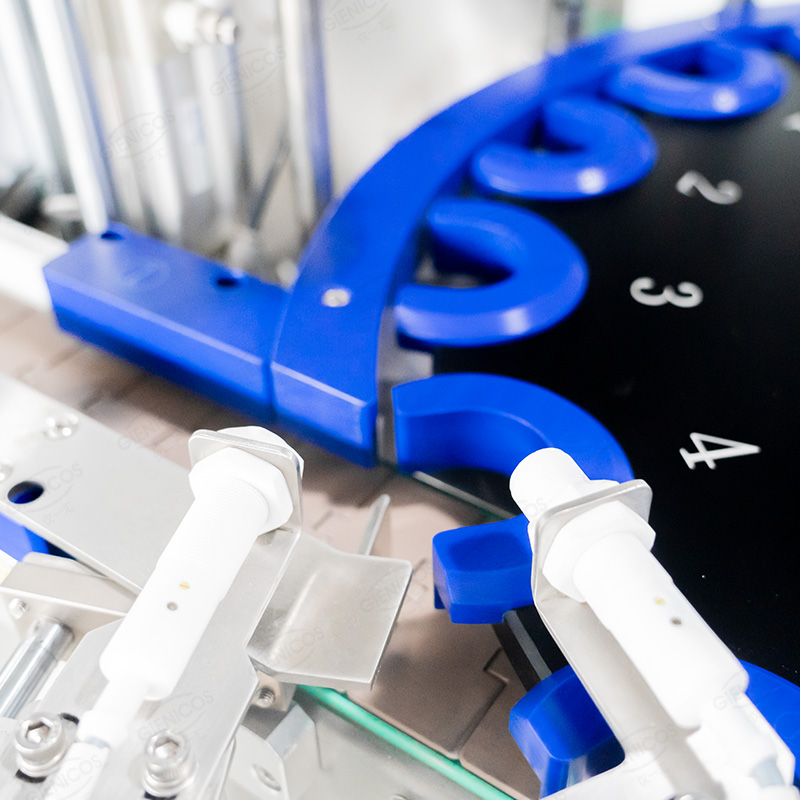
The JR-4 product page states that a photoelectric sensor checks for an empty bottle on the rotary table. The control system prevents filling, corking, and capping when no bottle is detected. GIENICOS also describes no-bottle no-fill and no-cap no-capping functions.
Ask the operator to demonstrate these controls on the ordered essential oil filling line. Remove a bottle, interrupt supply, and restart. Confirm how the line identifies the missing item and resumes production. Test recovery as well as steady operation.
Confirm Closure Feeding and Capping Torque
Closure handling helps determine whether an essential oil filling line is production-ready. The JR-4 NEW can automatically sort and load flat caps or dropper caps. Its servo-driven capping system has adjustable speed and torque.
Provide production-grade bottles, droppers, plugs, and caps for testing. Small differences in component dimensions can affect pickup, placement, and tightening. Approve the essential oil filling line with each commercial closure that appears in the purchase scope.
Make Change Parts Easy to Identify
The JR-4 page describes magnetic fixed cup holders for easier replacement. Ask which bottle formats share one holder and which need a separate set. Identify each essential oil filling line holder in the documentation.
If the essential oil filling line will serve several SKUs, request a format-change demonstration. Measure from the last accepted bottle of one format to the first accepted bottle of the next. Include holder changes, guides, cap-feeder setup, labels, and first-piece approval.
Select Sealing and Labeling Around the Package
The JR-4 NEW configuration offers several downstream functions. GIENICOS lists a water-cooled induction sealing machine, a high-speed sleeve-shrink labeling machine for neck shrink on flat caps, and a round-bottle labeler for half-round or full-round labels.
Choose only the functions required by the commercial package. The essential oil filling line specification should name the bottle, closure, seal, sleeve, label position, and label type for every SKU. It should also list samples required before design approval.
Inspect Finished Bottles During FAT
For each format, check filling, closure position, capping, seal placement, label position, wrinkles, and bottle cleanliness. Run the essential oil filling line through normal replenishment and adjustment. Keep approved samples with the acceptance record.
GIENICOS recently reported a customer FAT for its JQR-01A rotary filler. It covered operation, filling, station coordination, package handling, continuous running, and adjustment. Use the same evidence-based approach for an essential oil filling line.
Review Labor and Daily Operation
GIENICOS describes the JR-4 NEW essential oil filling line as fully automatic and says one or two operators can monitor it and add empty bottles. Confirm the actual work during a trial.
Map bottle loading, product supply, cap and label replenishment, quality checks, collection, cleaning, and changeovers. The buyer still needs a clear staffing plan around the essential oil filling line.
Check Access Controls and Routine Adjustments
The JR-4 NEW essential oil filling line has a stainless-steel frame and safety door, which GIENICOS states meets GMP standards. Ask operators to show access points and procedures for clearing bottles, changing holders, replacing labels, and responding to alarms.
Training should match the delivered essential oil filling line. Include startup, shutdown, format change, parameter adjustment, cleaning, routine inspection, fault response, and safe access. Record the final settings for every approved SKU.
Calculate the Full Project Cost
Purchase price is one part of an essential oil filling line project. Include change parts, samples, utilities, packing, shipping, installation support, training, spare parts, and trial materials.
For the JR-4 NEW, GIENICOS lists 2.5 kW power, 12 A current, 0.5 to 0.8 MPa air pressure, and 220 V or 380 V options. Confirm the destination factory’s electrical design before essential oil filling line production begins.
Compare Flexibility With Actual Demand
Compare each option with the confirmed product plan. Check whether the essential oil filling line can handle the planned bottles, fill volumes, flat caps, dropper caps, seals, and labels with defined change parts.
This separates the base essential oil filling line from future upgrades or packaging stations.
Confirm Customization Delivery and Support
GIENICOS positions itself as a cosmetic machinery manufacturer and automation solution provider for projects such as an essential oil filling line. Since 2011, its scope has covered design, manufacturing, material preparation, heating, filling, cooling, compacting, packing, and labeling.
Use that scope when discussing an essential oil filling line as a connected process. Define sample submission, layout approval, engineering review, assembly, trials, FAT, packing, shipment, commissioning support, and training. Give each milestone an owner.
Review Remote Service and Documentation
The JR-4 page describes a modular after-sales system that allows technicians to monitor machine operating status and locate faults. Confirm which remote functions are included in the ordered essential oil filling line and what site connection is required.
Request instructions, electrical and pneumatic information, change-part lists, spares, maintenance guidance, and approved essential oil filling line settings.
Choose a Supplier That Can Test the Complete Process
GIENICOS states that its products hold CE certificates and 12 patents and that its products and services cover more than 50 countries. The purchase decision should still rely on the ordered configuration and recorded test results.
The right essential oil filling line should match the formula and package, balance filling with capping and labeling, support changeovers, pass acceptance with production samples, and include a clear delivery and support plan.
Prepare your product data, bottle and closure samples, fill-volume range, label drawings, target output, factory utilities, and acceptance criteria. Contact GIENICOS to review an essential oil filling line configuration and arrange product testing around your actual packaging process.
Post time: Nov-27-2026